


















Many people in today’s modern society have glasses or some sort of vision impairment tool, such as glasses, monocles, reading glasses, lasik surgery, or contacts. Every person has different needs for their vision. Some people prefer glasses and others prefer contact lenses. But which is right for you? Let us talk about what some of the pros and cons are of contact lenses and whether they are the right move for you.
First, what even are contact lenses? There are several different types of contact lenses that each have their own uses and purposes for different people. There are soft contact lenses, which are the most common type of contact. Soft contact lenses are flexible and “soft” like. They are typically more comfortable and easier for people to wear on a regular basis, but they can break or tear. There are also rigid gas-permeable lenses. These are “hard” contact lenses that are much more resistant to damage compared to the soft lenses. But these lenses are often found to be harder to get used to and less comfortable to wear at first. But now, for what the lenses are actually made of. Contact lenses can vary depending on the type of lens. But lenses like soft contact lenses are typically made from a flexible plastic material that can easily shape around your eye on its own. But because of the material, they can easily absorb pollutants and irritate the eyes from chemicals on your hands or fingers. Hard contact lenses or gas-permeable contact lenses are made from silicone polymers. This makes it more difficult for the lenses to get contaminated by chemicals on your hands and fingers. But these are not the only contact lens options. There are also Hybrid, Toric, Multifocal, Scleral, Orthokeratology, and Cosmetic lenses. All of these serve different purposes. The hybrid lenses have a hard center, but soft edges. The toric lenses are made to correct astigmatism and help with poor vision. This is what I use. Multifocal lenses help with nearsightedness and farsightedness at the same time. These are more common in older people due to vision loss from aging. Scleral lenses are pretty much just bigger contact lenses. Instead of sitting on the iris of your eyes. They actually also rest on the white parts of your eyes. Orthokeratology lenses are only worn when sleeping and shape your eyeball temporarily to correct your vision for a certain duration of time. Finally, cosmetic lenses are just for fashion. These can be used to change your eye color temporarily or add cool designs to your eyes.
Now, let’s talk about what the pros are of contact lenses overall. Once you get contact lenses, you will typically have better overall vision compared to your vision with glasses. This is because instead of having fixed angles in which you can see clearly, the lens moves with your eye and lets you see clearly from any angle. Also, you don’t have to worry about damaging your glasses anymore. One thing you can do now, also, is wear sunglasses! Also, some people look better with contact lenses rather than glasses, so they can be a fashion choice as well.
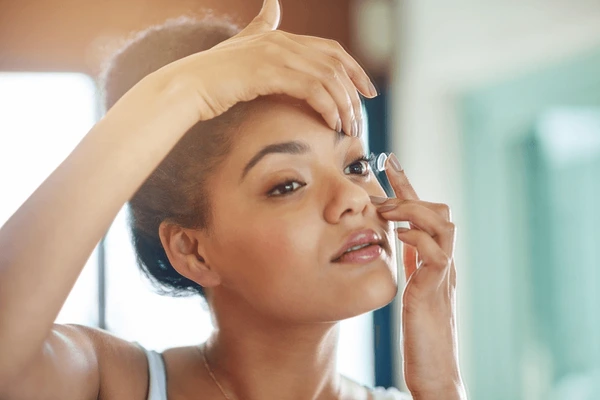
Now, for the cons of contact lenses. If you have soft lenses, which are the most common type of contact, you have to be careful when handling them because they can rip or tear. They also absorb pollutants easily and can badly irritate your eyes. Another con of contact lenses is that they are less “grab n’ go” compared to glasses. When you first get contacts, they can be quite a pain to actually get in your eyes when you are still getting used to putting them in and taking them out. Also, you have to take out your contacts every night before you go to sleep, or else they can dry out and damage your eyes. Another thing is that you can’t rub your eyes as you normally would with glasses; otherwise, you risk pushing the contact lens behind your eyelids. When wearing contacts, you also cannot go swimming or do anything that involves submersion in water, this is because the contacts can fall out of your eyes and get lost. One last con of wearing contact lenses is that you need to be extremely careful when dealing with ovens or super-hot surfaces/areas. If you are standing in front of an oven door and open it with contact lenses in, they can melt into your eyes.
Now, I interviewed several people who have had contact lenses for a large majority of their lives, and asked them what it is like having contacts and what their experiences have been with them thus far. When asked whether or not they preferred contact lenses or their regular glasses, all of them said they preferred contacts. Each of them also wear contacts a majority of the time. When asked what they thought the pros of contacts were, they each said they had better vision and overall visibility, and that they didn’t have to worry about their glasses throughout the day. Another big pro for people was being able to wear sunglasses when driving. Sure, you can get prescription sunglasses or change glasses lenses, but those can be extremely expensive, when you can get a pair of decent-looking sunglasses for under $25. When asked what they thought the primary cons of contact lenses were, a majority of them said, “You can’t wear them when doing water activities,” “You ‘have’ to replace them more often than glasses,” “Learning to have to touch your eyes with your fingers,” and “They are not as grab n’ go as glasses are.” Two of the four people I interviewed took their contacts out every night, while the other two left them in for somewhat extended periods of time, and one left them in almost constantly, only taking them out when their eyes get dry or they need to go to the eye doctor. Of the three who occasionally left them in overnight, only one ever reported having side effects. These people were having extremely irritated and dried out eyes. One of the subjects has had contacts for 6 years, while all of the others have had them for 20+ years.
Overall, contacts are perfect for some people, and not so perfect for others. It all depends on your routine and needs. With contacts, you have better vision than with glasses, and don’t have to worry as much about damaging your expensive glasses. But on the other hand, you have to get used to putting your contact lenses in and making sure not to pollute them and irritate your eyes. Do contacts sound like they would work for you?